Nuanced Mickey Mantle Explored in A Season in the Sun

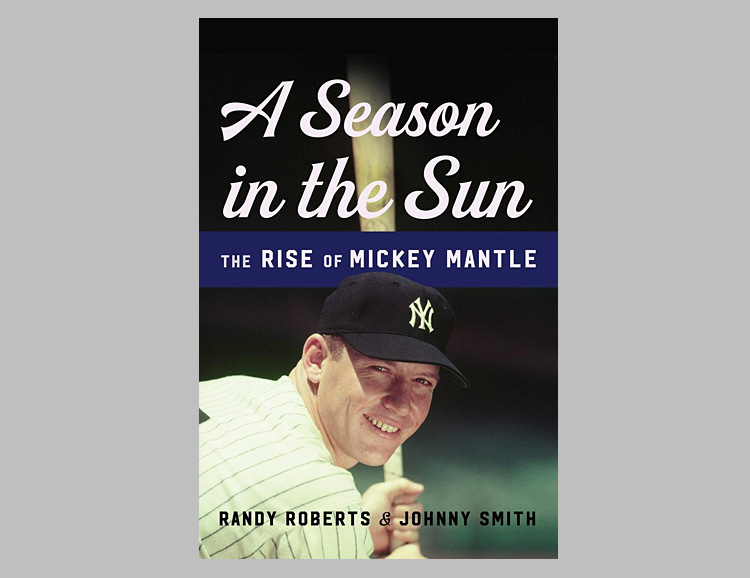
Baseball’s opening weekend is the perfect time to study the rich history of America’s pastime. Giancarlo Stanton and Aaron Judge are the modern power kings of New York, next in line of a legacy that dates back to Babe Ruth. After the Babe, perhaps no member of the Yankees’ seemingly perpetual dynasty is more important than Mickey Mantle. The Commerce Comet, as he was dubbed by the 1950s New York media, defined not just an era of baseball, but an era of American history. Seen as a future legend from his major league debut, Mantle truly came of age in 1956, a season in which he won the AL Triple Crown. In this complicated period of American history, no person better personified the complexities of American culture than Mickey Mantle. It is these circumstances that Randy Roberts and Johnny Smith investigate within the pages of A Season in the Sun. The two history professors of Purdue and Georgia Tech, respectively, masterfully spin a narrative that places Mantle and his trials as a microcosm of America during the evolving decade.
The early pages tell of Mantle’s humble beginnings as the son of a miner in Commerce, Oklahoma. Born in 1931, Mantle’s love of baseball was shaped by his father. Living in rural simplicity, the hustle and bustle of New York sent the young outfielder into a cultural shock. Further complicating his transition to the major leagues was a serious knee injury in the 1951 World Series. It was the first of many injuries that would hamper Mantle’s illustrious career. For much of it, Mantle played in pain, whether it was the knee, ankle, wrist, or some other body part.
As Roberts and Smith show; however, this did not stop the kingmakers of the New York media from anointing Mantle next-in-line, especially after the retirement of Joe DiMaggio. However, the brusque nature of the young Mantle’s personality did not endear him to these same writers. Despite the heap of expectations and the solid performances in the early 1950s, Mantle had to face harsh criticism daily from the most influential writers in the world’s brightest city. That is, until 1956.
Apparently, Mantle came into this 1956 breakout season with a different attitude. He was approachable, finally giving the appearance of familiarity under the microscope. Tales of Mantle’s exploits, both on and off the field, jump off the page. Herculean home runs, followed by tales of booze-driven adventures. For Americans, alcohol was the drug of choice in the 1950s, and Mantle was no exception. A Season in the Sun does not beat around the bush; it portrays Mantle as he was: a complex yet talented person that enjoyed the spoils of life.
The postwar decades saw a decline in baseball’s popularity, as stars such as DiMaggio retired and others like Ted Williams aged. The rise of television also contributed to a fall in attendance. The game itself felt moribund. To offset this negative trend, baseball needed a spark. Into this void stepped Mantle, who during his 1956 season, threatened to break Babe Ruth’s single-season record of 60 home runs. Though he finished 8 homers short of the Babe, Mantle’s ride led him to the Triple Crown and catapulted him into the stratosphere of stardom.
Journalists of the time crafted Mantle as an Adonis, the ideal American figure during the dregs of the early Cold War, a time when America needed an icon of brute exceptionalism. The “hayseed” from Oklahoma didn’t really need the help in that summer of 1956. Thanks to his incredible feats on the baseball field, Mantle was the most visible man in the nation. His face appeared on television sets seemingly every day, either on talk shows or commercials. Well-read magazines such as Life and Sports Illustrated produced featured stories on Mantle seemingly every week, crafting the image of an American hero. As the economy boomed and consumer culture entrenched itself, Mantle reached the apex of his popularity at the perfect time.
By the conclusion of this book, it’s clear that Mantle was not the perfect, family-friendly emblem of a thriving country. Not only is this book the tale of Mickey Mantle, but its pages tell of other intriguing figures, both in and outside of baseball. Ted Williams, Jackie Robinson, Billy Martin, President Dwight Eisenhower, and others, are all featured prominently within the scope of Mantle’s legendary season. Overall, A Season in the Sun is a must-read for not just any baseball fan, but anyone interested in the peculiarities of postwar American culture. A Season in the Sun hit shelves on March 27th and is published through Basic Books.
-Nick Schwartz